
Summary
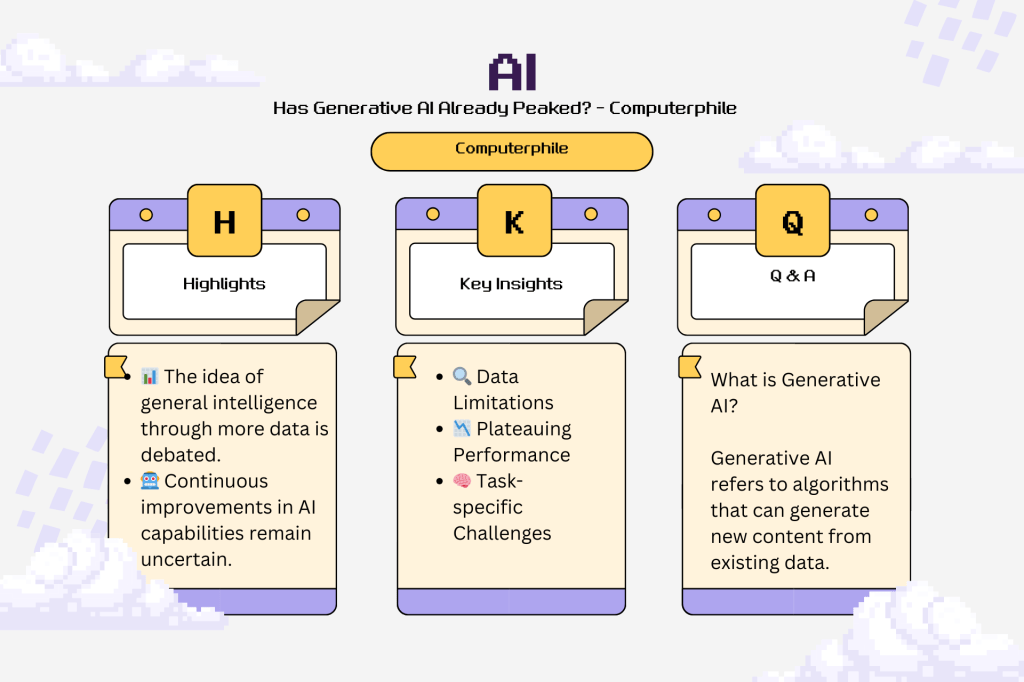
The discussion centers on the limitations of generative AI, challenging the notion that simply adding more data will lead to significant advancements in AI capabilities.
Highlights
- 📊 The idea of general intelligence through more data is debated.
- 📉 A recent paper suggests data requirements for performance may be astronomically high.
- 🐱 Current models excel at simple tasks but struggle with complex classifications.
- 📈 The performance of AI models may plateau despite increased data and model size.
- 🔍 Diverse datasets are essential for effective AI, but many concepts are underrepresented.
- 💡 Generative AI’s potential is limited for specific, nuanced tasks.
- 🤖 Continuous improvements in AI capabilities remain uncertain.
Key Insights
- 🔍 Data Limitations: Simply increasing data does not guarantee improved performance in generative AI; a substantial amount of quality data is required for complex tasks.
- 📉 Plateauing Performance: The evidence suggests that AI performance could plateau, challenging the assumption that more data will always lead to better results.
- 🤔 Underrepresented Concepts: Many specific tasks suffer from a lack of sufficient training data, leading to degraded performance on nuanced queries or classifications.
- 💡 Need for Innovation: Current methods may not suffice; new strategies beyond merely increasing data size and model complexity might be necessary for significant improvements.
- 🧠 Task-specific Challenges: Generative AI performs well on common tasks but struggles with specialized ones, indicating a gap in its training diversity.
- 📊 Importance of Empirical Evidence: The reliance on experimental data over theoretical assumptions is crucial for understanding AI’s true capabilities and limitations.
- 🔄 Future of AI Development: As companies push for larger models, the real question remains whether true advancements will emerge or if they will merely yield marginal gains.
Introduction
Generative AI has been heralded as a groundbreaking technology, capable of transforming industries through its ability to create images, text, and more. As we explore whether generative AI has hit a plateau, it’s essential to analyze recent research, data limitations, and the implications for future advancements.
Understanding Generative AI
What is Generative AI?
Generative AI refers to algorithms that can generate new content from existing data. These systems learn patterns from vast datasets, allowing them to create new images, sentences, or even music.
The Role of Data
Data is the lifeblood of generative AI. The more diverse and extensive the dataset, the better the AI’s potential to learn and perform complex tasks. However, the relationship between data size and model performance is not always linear.
The Current Landscape of Generative AI
Recent Developments
Recent papers have questioned the trajectory of generative AI, suggesting that merely increasing data size may not yield the expected performance increases. This leads to speculation about whether the field has reached its zenith.
Key Research Findings
A recent study analyzed the effectiveness of various generative models. It established that while data quantity is crucial, the quality and diversity of that data matter immensely for tackling difficult tasks.
Analyzing the Data-Performance Relationship
Performance Metrics
The paper highlighted the performance of generative AI in tasks such as image classification and recommendation systems. It showed that the efficiency of these systems varies significantly based on the complexity of the task and the data available.
Graphical Representation of Findings
The study produced graphs illustrating that as the number of examples in training sets increases, performance may initially improve but can plateau or even decline for more complex tasks.
The Limitations of Current Models
Data Representation Challenges
One major takeaway is that certain categories (like specific species or complex medical diagnoses) are often underrepresented in training datasets. This imbalance leads to diminished performance when the AI is confronted with nuanced or difficult queries.
The Logarithmic Growth of Performance
The research suggests that instead of exponential growth in model performance with increased data, we may be facing a logarithmic curve, indicating diminishing returns.
Future Directions for Generative AI
Beyond Bigger Models
To enhance generative AI capabilities, researchers may need to explore new algorithms or strategies beyond simply adding data. This might include incorporating more sophisticated machine learning techniques or alternative data sources.
The Need for Quality Over Quantity
Emphasizing the importance of high-quality, diverse datasets could lead to improved performance in generative AI applications, particularly for complex tasks.
Conclusion
The question of whether generative AI has peaked remains open. While recent research indicates potential limitations related to data and model performance, the evolution of this technology is ongoing. Continued exploration into new methodologies and better data practices will be essential in determining the future trajectory of generative AI. As we move forward, it will be crucial to balance optimism for advancements with a realistic understanding of the challenges ahead.
This structured overview encapsulates the critical aspects of generative AI, its current state, and potential future developments, providing a comprehensive guide for readers interested in the topic.


 Skipeon